
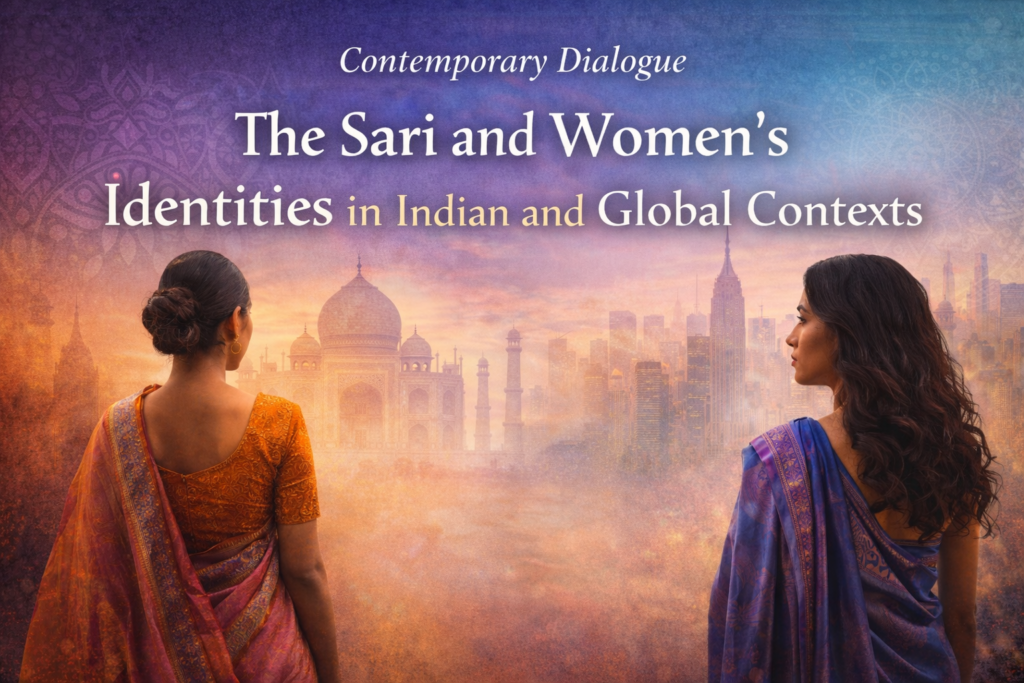
The Sari as Cultural Text
Clothing often functions as more than adornment; it operates as a cultural text through which societies encode values, hierarchies, and histories. The sari, one of the most enduring garments in South Asian traditions, exemplifies this layered symbolism. Across regions, religions, and linguistic communities, the sari has persisted not as a fixed costume, but as a dynamic medium of cultural continuity.
From temple rituals to domestic ceremonies, from rural landscapes to metropolitan boardrooms, the sari occupies both sacred and secular spaces. Its fabric carries memory — of lineage, locality, craftsmanship, and generational transmission. Yet it is precisely this continuity that makes it a powerful site of reinterpretation.
“The sari invites us to reconsider how identity is woven through everyday practice. It is easy to interpret traditional garments as static symbols of culture, yet the sari reveals something far more complex. It shows us how women inhabit tradition while simultaneously reshaping it.”- Dr Neha Sharma
Between Ritual Obligation and Self-Expression
Drawing on literary, anthropological, and sociological perspectives, this dialogue argues that the sari is not merely clothing but a narrative medium. It becomes a site where women negotiate the tension between inherited expectations and personal agency.
In ritual contexts, the sari may symbolize modesty, marital status, caste location, or cultural propriety. At the same time, the act of draping, styling, or recontextualizing the garment offers space for subtle self-expression. Literary representations often portray women who transform the sari’s meaning — altering its color, fabric, or mode of wearing to signal dissent, aspiration, or autonomy.
Thus, the sari exists within a continuous negotiation. It both preserves tradition and allows reinterpretation. Through everyday decisions about how and when to wear it, women reshape the symbolic script embedded within its folds.
Migration, Diaspora, and Global Identity
In global contexts, the sari acquires additional layers of meaning. For diasporic communities, it often functions as a bridge between homeland and host society. Worn at cultural festivals, academic events, weddings, or political gatherings, it becomes a visible marker of heritage and belonging.
Anthropological studies demonstrate that in diaspora settings, the sari may signify nostalgia, resistance to assimilation, or hybrid identity formation. It may also become a site of cosmopolitan reinvention, adapted to contemporary aesthetics and global fashion circuits.
In these spaces, the sari is no longer confined to ritual obligation; it becomes a conscious declaration of cultural presence within pluralistic societies. It embodies both rootedness and mobility.
Power, Profession, and Public Presence
Sociologically, the sari intersects with class mobility, political identity, and professional authority. It has been worn by political leaders, activists, artists, and corporate executives, signaling dignity, continuity, and national identity. At times, it has functioned as a symbol of resistance; at others, as an emblem of institutional legitimacy.
The sari’s adaptability reveals that tradition is not static but dialogical. Its continued relevance demonstrates how material culture evolves in response to social change. Women wearing the sari in contemporary public spaces are not merely preserving heritage; they are actively reshaping its meaning.
Material Culture and the Making of Identity
This contemporary dialogue ultimately positions the sari as a narrative instrument through which identity is continually constructed. Identity is not singular or fixed; it emerges at the intersection of history, gender, mobility, memory, and choice.
By examining the sari through interdisciplinary lenses, we gain insight into how material objects participate in broader conversations about autonomy, belonging, and transformation. The sari becomes a living archive — one that records both conformity and resistance, continuity and change.