Rethinking Health in the Era of Systems Medicine
Modern biomedicine is increasingly recognizing health not merely as the absence of disease, but as an emergent property of dynamic, system-wide regulation. The growing emphasis on precision medicine, adaptive physiology, and whole-person care reflects a paradigm shift toward understanding the body as an interconnected network of regulatory processes.
Interestingly, this movement parallels the classical Ayurvedic understanding of health through the dynamic balance of the Tridoshas—Vata, Pitta, and Kapha. For centuries, Ayurveda has described health as the harmonious interplay of physiological, psychological, and environmental regulation. Yet despite these conceptual resonances, biomedical science and Ayurvedic theory have largely evolved in isolation.
This paper seeks to bring these frameworks into dialogue.
“This work emerged from a simple yet profound question: Can ancient constitutional frameworks inform modern precision health without being reduced to metaphor or mysticism?
The Tridosha model describes variability in a way that resonates deeply with systems biology. If precision medicine seeks to understand why individuals respond differently to the same environment or treatment, then constitutional models such as Tridosha deserve thoughtful scientific engagement. Integrative dialogue, grounded in both rigor and cultural humility, may help shape the next generation of whole-system healthcare.”
The Tridosha Model and Systems Biology
The study presents a narrative evidence synthesis linking the Tridosha model with biomedical mechanisms such as homeostasis, allostasis, and adaptive regulation. Rather than attempting reductionist equivalence, it explores systemic correspondences between constitutional patterns and measurable biological parameters.
Drawing upon clinical observations, practitioner narratives, and community-based experiences, the research identifies meaningful parallels:
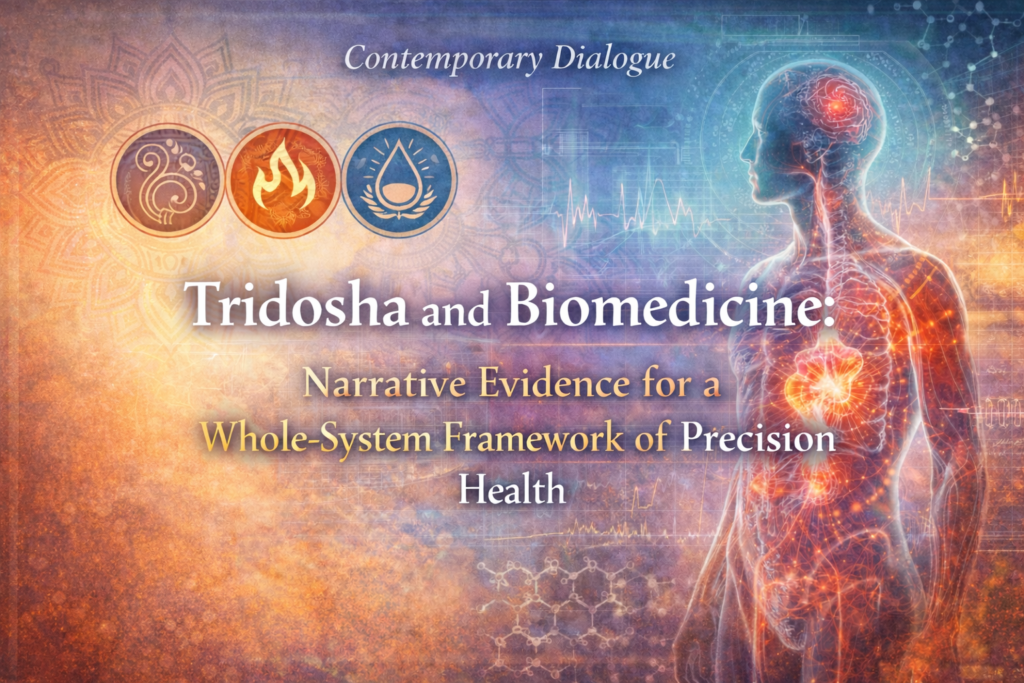
- Vata is interpreted as correlating with neural regulation and autonomic variability, reflecting movement, signaling, and dynamic responsiveness.
- Pitta aligns with metabolic and thermogenic regulation, including enzymatic activity, inflammatory processes, and endocrine balance.
- Kapha corresponds to anabolic processes, immune stability, structural integrity, and long-term physiological resilience.
Through narrative case vignettes and reflective synthesis, the study demonstrates how Tridoshic patterns may map onto measurable biomedical markers such as autonomic variability, metabolic rate, inflammatory status, and neuroendocrine adaptation.
Narrative Evidence as a Bridge
A central contribution of this work lies in its methodological approach. By foregrounding narrative evidence—clinical reflections, experiential accounts, and community practice—the paper highlights how lived experience can illuminate patterns that quantitative models alone may overlook.
Narrative synthesis becomes a bridge between experiential wisdom and empirical science. It enables a culturally grounded, systems-level understanding of individual variability, aligning closely with contemporary movements toward personalised and integrative medicine.
Rather than positioning ancient constitutional theory in opposition to biomedicine, the study reframes it within the language of systems biology. In doing so, it proposes that Tridosha theory may offer a coherent interpretive framework for precision health—one that integrates mind, body, and environment.
Implications for Precision and Integrative Medicine
As healthcare shifts toward predictive, preventive, personalised, and participatory models, there is growing recognition that variability—not uniformity—is central to health. Constitutional diversity influences metabolic responsiveness, stress adaptation, immune function, and therapeutic outcomes.
By articulating correspondences between Tridosha theory and adaptive physiology, this research opens new directions for:
- Integrative diagnostic frameworks
- Adaptive, constitution-informed therapeutics
- Community-based preventive health models
- Cross-cultural models of personalised care
This approach does not replace biomedical rigor; rather, it expands the interpretive lens through which health variability is understood.
The Way Forward
The convergence of systems biology and constitutional medicine marks a promising frontier in global health discourse. Moving forward, interdisciplinary collaboration will be essential. Empirical research, clinical trials, physiological measurement, and narrative scholarship must work in concert to deepen understanding.
Future directions include:
- Biomarker-based validation studies of Tridoshic patterns
- Integrative clinical pilot models
- Cross-cultural comparative research
- Development of adaptive diagnostic tools informed by constitutional profiling
By reframing ancient knowledge within contemporary scientific paradigms, this work contributes to a broader vision of healthcare—one that recognizes health as relational, adaptive, and emergent.
Through sustained interdisciplinary dialogue, precision health can evolve into a truly whole-system model—honoring both empirical science and lived wisdom.
Access the Full paper: Tridosha and Biomedicine: Narrative Evidence for a Whole-System Framework of Precision Health | Request PDF